Most people hurt in an accident spend the first few days focused on pain, doctors, and insurance calls. What they don’t realize is that the evidence window, the critical hours and days right after the incident, closes fast.
West Seattle has its own traffic patterns, commercial strips, and community spaces that shape how accidents happen and, just as importantly, how cases are built. If you’ve been hurt here, knowing what evidence matters isn’t just helpful. It’s the difference between a strong claim and a dismissed one. At Pathfinder Attorneys, we help West Seattle residents build that foundation from day one.
How West Seattle’s Local Conditions Shape the Evidence in Your Case
Where your accident happened in West Seattle actually changes what evidence exists, who has it, and how quickly it disappears.
West Seattle Bridge Corridor Accidents: Why Surveillance and Traffic Reports Matter More Here
The West Seattle Bridge and the Spokane Street Viaduct funnel an enormous amount of daily traffic into a relatively narrow set of entry and exit points. Accidents in this corridor, merges gone wrong, rear-end collisions at the on-ramps, sudden stops near the Highland Park interchange, happen in areas that are often covered by WSDOT traffic cameras and sometimes by nearby commercial surveillance.
Here’s the thing about that footage: it doesn’t get preserved automatically. WSDOT typically overwrites camera footage within days. Private businesses follow their own retention schedules, often 30 to 72 hours. If you wait too long to request it, it’s gone. Your attorney needs to move fast, send preservation letters, and sometimes issue subpoenas before that window closes.
Traffic incident reports from WSDOT and Seattle PD are also particularly detailed for this corridor; they log lane positions, merge behavior, and weather conditions. Those details matter when liability isn’t immediately obvious.
Slip and Fall Cases on Commercial Strips, What Counts as ‘Notice’ on California Ave SW and Admiral District
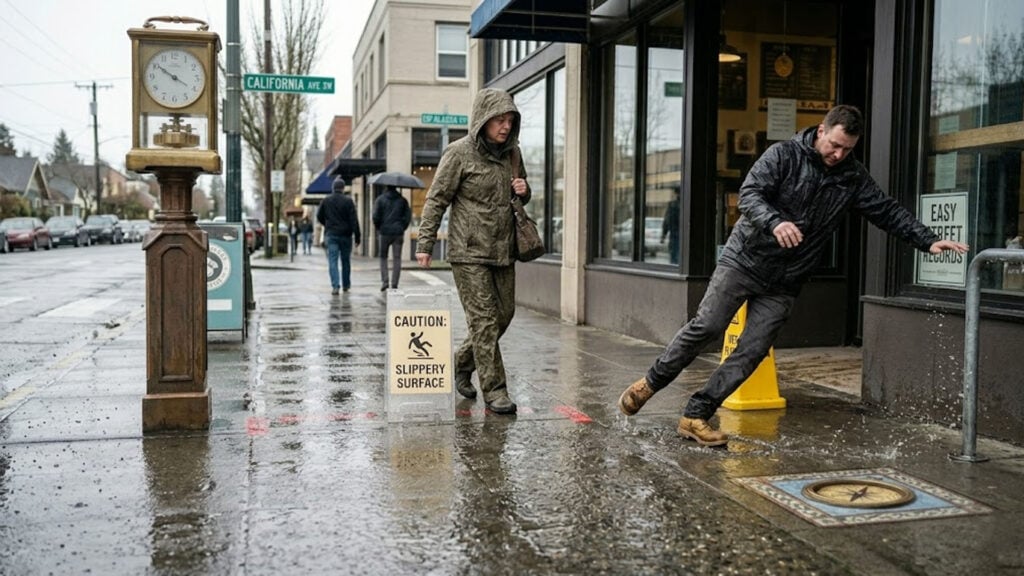
If you slipped or tripped at a business on California Avenue SW, in the Admiral District, or at any West Seattle commercial property, the central question isn’t just that you fell. It’s whether the property owner knew, or reasonably should have known, about the hazard and failed to fix it.
That’s the legal concept of “notice”, and evidence here takes a specific shape. Maintenance logs, incident reports filed with the business, prior complaints, inspection records, and timestamped surveillance showing how long a hazard existed; these are the pieces that establish notice. For example, a Seattle woman was awarded $13 million after slipping on an algae-covered sidewalk precisely because records showed the property had been neglected over time. The hazard wasn’t sudden. It was documented.
The first thing to do after a commercial slip and fall in West Seattle: photograph the scene immediately, report it to the business in writing, and preserve your footwear. Shoes are physical evidence. They get thrown away.
Pedestrian and Cyclist Accidents Near the Junction
The Junction area, around SW Alaska Street and California Ave SW, sees heavy foot and bike traffic, especially on weekends. Crosswalk violations, failed yields, and dooring incidents are common. What makes these cases distinct is that evidence often lives in the hands of strangers: bystanders, nearby café patrons, passing drivers with dashcams.
Get witness contact information before anyone leaves the scene. People want to help in the moment, and they disperse within minutes. A name and a phone number, collected right there, can become a signed statement later that corroborates exactly what happened when the light was green, and the driver wasn’t looking.
Also worth noting: cyclists and pedestrians in Washington can still recover damages even if they’re found partially at fault, more on that in a moment.
The Core Evidence Types That Actually Move the Needle in a Personal Injury Claim
Here’s what every strong West Seattle personal injury case is built on, and what most people underestimate or miss entirely.
- Medical Documentation, Timing, and Consistency Are Everything
Getting checked out by a doctor after an accident isn’t just about your health; it’s about creating a record. Insurance adjusters look hard at two things: how soon after the accident you sought treatment, and whether your medical visits are consistent with the injuries you’re claiming.
A gap in treatment, even one caused by life getting in the way, gets used against you. Adjusters frame it as “if you were really hurt, you would have kept going to the doctor.” It’s not fair, but it’s how these evaluations work.
What strengthens a medical record as evidence: detailed physician notes (not just diagnoses), physical therapy records, specialist referrals, and documentation of how the injury affects your daily life — work, sleep, mobility. The more specific, the harder it is to minimize.
- Washington’s Comparative Fault Law (RCW 4.22), And Why Your Evidence Strategy Has to Account for It
Washington is a pure comparative fault state. That means even if you’re found 30% or 40% at fault for your own accident, you can still recover damages, just reduced by your percentage of fault. Sounds fair in theory. In practice, it gives insurance companies a strong incentive to build a case that you were partially responsible.
This is why your evidence needs to do two things simultaneously: prove the other party’s negligence and protect your own conduct. Photos that show you were in a legal crosswalk. Records showing you weren’t speeding. Witness statements that confirm you had the right of way. These aren’t just supporting details; they’re defensive evidence that limits how much of the blame gets shifted onto you.
An experienced attorney knows how to read this strategy early and build their evidence accordingly.
- Digital and Physical Evidence: Most People Walk Away From
Most people know to take photos at an accident scene. Fewer people think about the evidence that already exists, and starts disappearing, within the first 24 to 48 hours. Here’s what’s worth fighting for:
- Business surveillance footage from nearby shops, restaurants, or ATMs along the route
- Dashcam footage from other drivers is often never shared unless specifically requested
- Your own phone’s GPS and timestamp data, which can confirm your location and route
- Vehicle black box (EDR) data in car accidents, which records speed, braking, and steering inputs
- The clothing and footwear you were wearing are physical evidence that documents the impact
These aren’t obscure legal tactics. They’re the pieces that close the gap between “this person says they were hurt” and “here’s exactly what happened and here’s the proof”.
- When Expert Testimony Changes the Outcome
Some cases are decided on documents and witness accounts alone. Others need expert voices to explain what the evidence means, especially when the other side disputes the extent of your injuries or the mechanics of the accident.
Medical experts can testify about long-term impact and future care costs. Accident reconstruction specialists can piece together what happened when there are no witnesses. Vocational experts can quantify what your injury actually costs in lost earning capacity. These aren’t extras in complex cases; they’re what gets a fair settlement across the finish line instead of a lowball offer.

Your Evidence Window Is Open Right Now. Don’t Wait to Close It
West Seattle is a specific place, with specific roads, specific businesses, and specific patterns of how accidents unfold. Building a strong personal injury case here means understanding that local context, not just checking boxes on a generic evidence list.
The strongest cases start with early action: preserved footage, documented injuries, collected witness information, and an attorney who knows how Washington’s comparative fault law shapes everything that follows. Every day of delay is a piece of evidence that gets harder to recover.
At Pathfinder Attorneys, we work directly with you, not a case manager, not a paralegal. If you’ve been hurt in West Seattle, let’s talk through what you have and what we can build. Your consultation is free, and it starts with an honest conversation about your options.